The square peg challenge
Greetings optical designers, engineers, scientists, and tinkerers! You have received the most puzzling item. It bears some resemblance to the classical children’s toy, where you try to fit different shaped pegs into matching holes. But this one is different: You only have one peg. It is cube shaped, and it glows in the dark with the most curious angular emission pattern. And the hole? It is round and like a blackbody, perfectly absorbing all incoming light.
Naturally curious, you realize that the peg and hole are actually perfectly matched in terms of étendue. This means that, in theory, all the light from the cube peg can go into the round hole. But how?
You bring the item to your lab, and start brainstorming ideas. You have a 3D printer that can print arbitrarily shaped mirrors within a build volume of 500 mm x 500 mm x 500 mm. The mirrors come out perfectly specular, and with a reflectivity of 95%.
The challenge: Design a reflective optical system that takes all light emitted from the cube source and sends it into the circular hole. The highest efficiency wins.
The source
The cube has dimensions of 45 mm x 45 mm x 45 mm. Each surface has a spatially uniform emission, with a special angularly selective emissive surface. All light is emitted with a constant luminance, but only in the angular range 66.297° to 90.00° relative to each local surface normal. In other words, each of the six faces of the cube emits like a lambertian source, except that any light emitted at angles smaller than 66.297° relative to the surface normal is blocked.
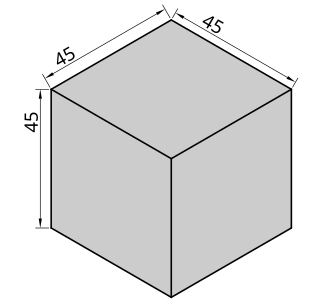
The cube is a regular cube with six faces, with side lengths 45 mm.
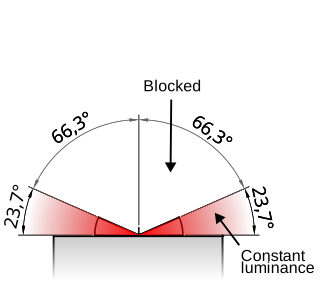
Each face of the cube emits light over the whole face with constant luminance, but only in the angular range 66° to 90.00° relative to the local surface normal.
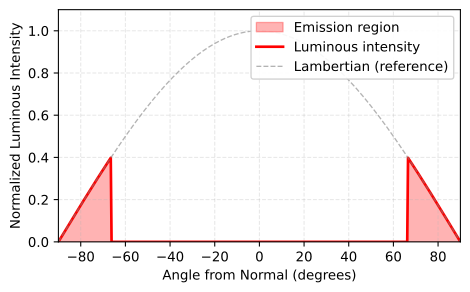
Cartesian plot of luminous intensity per face of the cube source. The constant luminance gives it a lambertian-like luminous intensity, except that there is no emission for angles lower than 66.297° from the local surface normal.
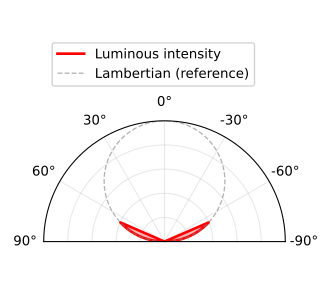
Polar plot of luminous intensity per face of the cube source.
The target
The target is a circular hole with radius 25 mm. All light entering the hole is considered successfully delivered, meaning that we can view the hole as a perfectly absorbing disc.
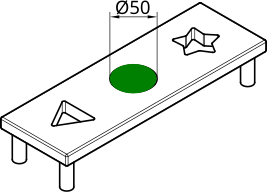
The target is to get all the light into the 50 mm diameter opening of this toy which is placed at the bottom of the build volume.
Coordinate system and build volume
Your 3D printer has a build volume of 500 mm x 500 mm x 500 mm. The origin of the coordinate system is at the center of the bottom face, with the x-axis and y-axis spanning the horizontal plane and the z-axis pointing upward. Valid coordinates are: x between -250 mm and +250 mm, y between -250 mm and +250 mm, and z between 0 mm and 500 mm. The target disc sits at the origin (z = 0), and your optical system must fit entirely within this volume.
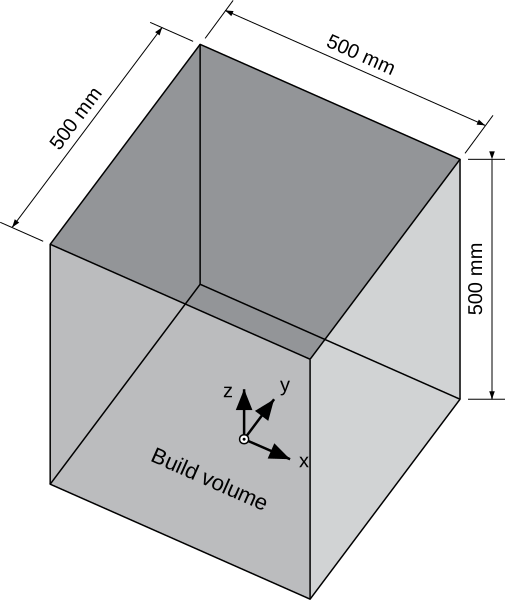
Build volume dimensions and coordinate system. The origin is at the center of the bottom face (x=0, y=0, z=0). The target disc is located at the origin.
You are free to position and orient the source cube as you like within the build volume, as long as its center is at least 39.0 mm away from any edge of the build volume. The cube’s position is given as the coordinates of its center point, and its orientation is given as intrinsic Euler angles in XYZ order (in degrees): the cube is first rotated around the x-axis, then around the (new) y-axis, and finally around the (new) z-axis. You can adjust both the position and rotation in the upload page.
Note that some CAD tools and STL exporters shift the geometry so that all coordinates are positive (i.e., the bounding box starts at the origin). If your exported file appears offset in the upload portal, you can use the position controls to translate it back into the build volume. Alternatively, exporting to STEP format avoids this issue, as STEP files preserve the original coordinate system.
Specific rules
- Your 3D printer is limited to a maximum build volume of 500 mm x 500 mm x 500 mm. The optical system must fit within this volume.
- Your 3D printer cannot print transparent materials, so you are limited to designing reflective optics only.
- Any light leaving the build volume is considered lost.
- The source is perfectly absorbing, and any light that is reflected back onto the source is considered lost.
- You are free to position and orient the source cube anywhere within the build volume, as long as its center is at least 39.0 mm away from any edge of the build volume.
- The target disc is located at the bottom center of the build volume (z = 0), with its surface normal aligned with the z-axis.
- Your 3D printer only supports files with a size up to 100 MB.
- The mirrors have a fixed reflectivity of 95%.
Evaluation
The winning design will be the optical system with the highest efficiency, as calculated in the submission portal. However, the committee may also choose to highlight other designs with interesting features or creative solutions. You can submit multiple designs to the competition if you want to explore different approaches.
Instructions
- Design your optical system using any Optical Design or CAD software of your choice.
- Export your design as an STL file or a STEP file.
- Upload your file on the upload page, and receive an immediate evaluation of your concentrator’s efficiency.
- If you are satisfied with your design, submit it for the competition.
Submission Deadline: June 1, 2026 June 15, 2026 (Submissions are now closed. You can still test new designs in the upload portal, but the designs cannot be submitted.)
Getting Started
To help you get started, we will prepare some resources for popular optical design software. Please check back soon!
Do you have questions?
Check out our FAQ page, or e-mail us at chairs@nonimaging-conference.org.